Why You Can't Opt Out of EDDM Junk Mail
No registry, no USPS form, and refusing a flyer does nothing. The laws and Postal Service rules behind that, what other countries do instead, and the one narrow exception.
By Jake WaitzmanUpdated Sources linked throughout
Short answer: No law or USPS rule lets a household opt out of Every Door Direct Mail. Your mailbox runs on Postal Service rules, EDDM uses no mailing list to take you off, refused “Postal Customer” mail is thrown away, and Congress has never created a Do Not Mail registry. That leaves the one exception, which only advertisers control: each sender can list your address as Do Not Deliver.
Is there really no way to opt out of EDDM?
Not for a household. There is no registry to join, no USPS form to file and no setting at the post office. EDDM is built that way: an advertiser pays to reach every address on a carrier route, using no names and no mailing list, so there is no list to take you off.
What exists is narrower, and it belongs to the advertiser. Since 2008 on rural routes, and since 2011 on city routes, USPS has let mailers exclude the addresses of people who asked them to stop. Its instructions for EDDM advertisers still say so today.
Who decides what goes in my mailbox?
The Postal Service, under rules you accept by putting up a mailbox. A 1934 law, 18 U.S.C. 1725, makes it a federal offense, punishable by a fine, to leave unstamped “circulars, sale bills, or other like matter” in a mailbox to avoid postage. USPS rules go further: a mailbox “may be used only for matter bearing postage.” Congress passed the law to protect postal revenue, according to a 1997 GAO review.
The Supreme Court upheld the arrangement in 1981, in U.S. Postal Service v. Council of Greenburgh Civic Associations. You pay for the box, the Court said, but you agree “to abide by the Postal Service's regulations in exchange for the Postal Service agreeing to deliver and pick up” your mail. The Court also noted the exit: nobody is required to get mail at home, and anyone can do without it “by simply failing to provide the receptacle.”
So the mailbox law does not force EDDM on you by itself. It keeps everyone else out and puts the Postal Service's delivery rules in charge, and those rules give households no way to turn saturation mail off. The statute and the court case, in detail.
Can I refuse mail addressed to “Postal Customer”?
You can, but it accomplishes nothing. USPS rules let you refuse a piece when it is offered, or mark it “Refused” and return it unopened. Mail with a simplified address is not sent back, though: undeliverable pieces addressed to “Postal Customer” are “disposed of as waste.” The advertiser never learns you refused it, and next week's flyer still comes.
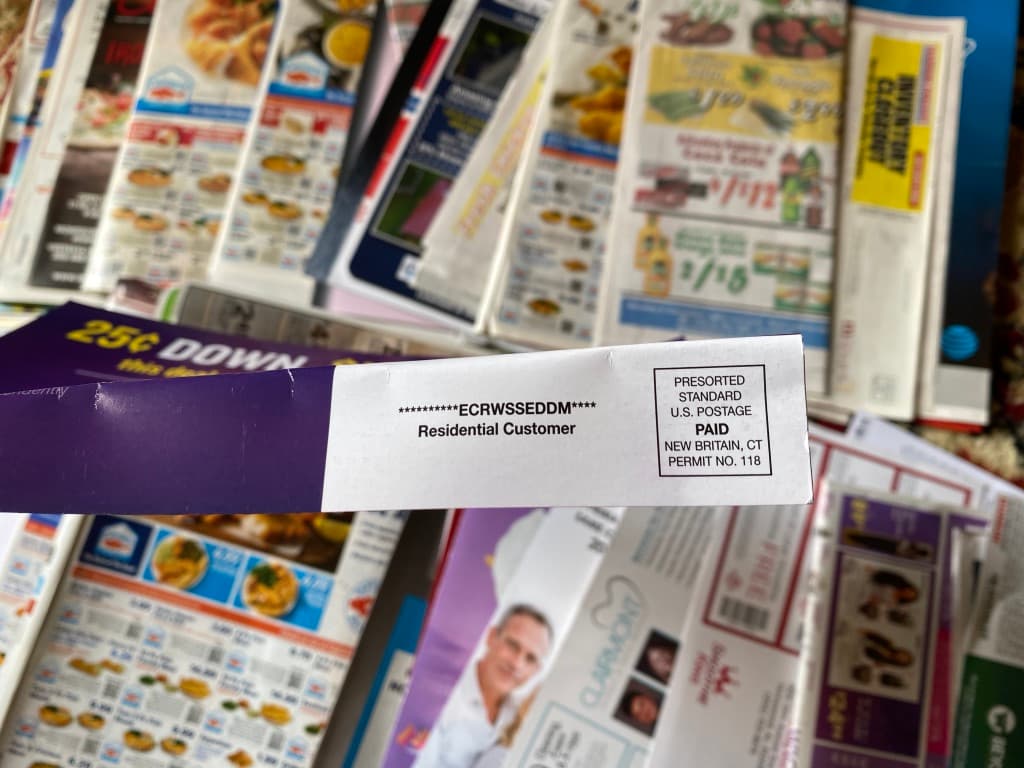
The address line is the reason. EDDM uses USPS's simplified address format, a generic line such as “Postal Customer,” “Local Postal Customer” or “Residential Customer” in place of a name and street, and USPS rules send it to all deliveries on the route. Mail addressed to “Current Resident” or “Occupant” is different: it carries your street address, comes from a list, and can usually be stopped (how to tell the two apart).
Why is there no Do Not Mail registry?
Because Congress has never created one, and the states that tried did not succeed. Phones got the National Do Not Call Registry from the Federal Trade Commission in 2003. Commercial email has to explain how to opt out, and senders must honor the request within 10 business days, under the CAN-SPAM Act of 2003. Advertising mail has no general equivalent (how mail compares with phones, email and fax).
In 2007 and 2008, at least 19 state legislatures introduced bills to create Do Not Mail registries, and none became law, the Congressional Research Service found. The mailing industry organized against them through a coalition called Mail Moves America, and the Postmaster General told a Senate subcommittee in March 2008 that the bills threatened “the viability of the mail.” USPS estimated that registries in every state could cost it $4 billion to $10 billion a year in revenue if half to all consumers signed up, an estimate CRS noted did not subtract the delivery costs USPS would save.
What the voluntary opt-out lists cover, and the push for a Do Not Mail registry.
Why doesn't the Postal Service offer an opt-out?
Nothing requires it to, and advertising is a large part of its business. USPS “generally receives no tax dollars for operating expenses” and lives on postage. Marketing Mail, the class most advertising travels in, was 52% of everything it delivered in fiscal 2025 (56.8 billion of 108.7 billion pieces) and brought in $15.7 billion, about a fifth of its revenue. In 2026 USPS is offering mailers a 30% postage credit for sending more Marketing Mail, saturation mail included.
EDDM itself is a small slice: about $617 million in fiscal 2025, roughly 0.8% of USPS's $80.5 billion in operating revenue. An opt-out used only by the households that want one would touch a fraction of that. The agency that would have to create the opt-out is the same one that sells the postage. Does EDDM keep the Postal Service afloat? The numbers.
Doesn't Rowan v. Post Office let me block junk mail?
Only in a narrow way. In Rowan v. U.S. Post Office Department (1970), the Supreme Court upheld a 1967 law, now 39 U.S.C. 3008, that lets a householder who receives an ad they consider “erotically arousing or sexually provocative” get a Postal Service order telling that mailer to stop sending them anything. The Court left that judgment to the householder alone, who “may prohibit the mailing of a dry goods catalog because he objects to the contents.” Its reasoning, that “a mailer's right to communicate must stop at the mailbox of an unreceptive addressee,” is the same principle an EDDM opt-out would rest on.
As a tool, though, it is narrow. Each order runs against one mailer. The application, PS Form 1500, must come with the original piece, opened. And the order covers only the people named in it, while EDDM pieces name no one. We found no record of a prohibitory order being used against an EDDM sender. How prohibitory orders work.
Does DMAchoice stop EDDM?
No. DMAchoice, a mail preference service now offered by the ANA (Association of National Advertisers), passes your name and address to the companies that subscribe to it, which drop you from their prospect mailings. EDDM uses no list, and DMAchoice says so in its own FAQ: its opt-out, “which uses both name and address for suppression will not work to stop EDDM mailings.”
It once tried. In August 2012 the Direct Marketing Association added a voluntary EDDM opt-out to DMAchoice that passed opted-out addresses to advertisers for their facing slips, if the advertisers chose to use it. That form no longer exists. DMAchoice still helps with addressed advertising, for $8 online (10 years), along with the free opt-outs that work.
Do other countries let households opt out?
Yes. Several let households refuse unaddressed advertising, and in Canada the national postal operator honors the request itself.
| Country | What households can do |
|---|---|
| Canada | Canada Post’s Consumers’ Choice program: a note on the mailbox stops unaddressed advertising. Government mailings, election material and community newspapers without inserts still arrive. |
| United Kingdom | Royal Mail’s free Door to Door opt-out stops unaddressed mail within about six weeks and lasts two years. The Mailing Preference Service covers only advertising addressed to you personally. |
| Netherlands | Opt-out stickers nationwide. Amsterdam switched to opt-in on January 1, 2018: unaddressed ads go only to mailboxes with a “ja/ja” sticker. Households receiving them fell by about 62%, from nearly 210,000 to just over 80,000, and the Dutch Supreme Court upheld the rule in 2021. |
| Germany | A “no advertising” sticker legally binds distributors, under a 1988 ruling of the Federal Court of Justice. The system is opt-out: households have to post the sticker. |
| United States | No household opt-out. Each advertiser can choose to skip an address on its USPS paperwork. |
What would it take to get an opt-out?
A decision by the Postal Service, or a law that requires one. USPS already skips addresses that advertisers list as Do Not Deliver. What is missing is a way for a household to ask once, instead of tracking down every sender. That is what the petition asks the Postal Service to create. What could change, from USPS rules to bills in Congress and the states.
EDDM opt-out questions, answered
Can I opt out of EDDM mail?
Not as a household. USPS has no registry, form or setting that stops Every Door Direct Mail. The one exception runs through advertisers: if you ask, each sender can list your address as Do Not Deliver on its USPS facing slip.
Can I refuse EDDM mail or write “Refused” on it?
You can, but nothing happens. USPS rules say undeliverable mail with a simplified address like “Postal Customer” is disposed of as waste rather than returned, so the advertiser never learns you refused it.
Can I ask my mail carrier to skip my house?
We found no USPS procedure that lets a household do that. USPS rules send “Postal Customer” mail to all deliveries on a route; the Do Not Deliver list belongs to the advertiser’s mailing, so the request has to go to the advertiser.
Does a “No Junk Mail” sign on my mailbox stop EDDM?
No. No USPS rule lets a household block saturation mail with a sign. Canada is different: Canada Post stops unaddressed advertising for any household that puts a note on its mailbox.
Does DMAchoice stop EDDM?
No. DMAchoice suppresses mail by name and address, and its own FAQ says it “will not work to stop EDDM mailings.” It can still cut addressed advertising from companies that subscribe to its list.
Why is there a Do Not Call registry but no Do Not Mail registry?
The federal government opened the National Do Not Call Registry in 2003. Congress has never passed a Do Not Mail law, and the Do Not Mail bills that at least 19 state legislatures introduced in 2007 and 2008 all failed.
Does Rowan v. Post Office let me stop junk mail?
Only in a narrow way. Rowan (1970) upheld a law that lets you stop all further mail from one sender at a time, once it has sent you an ad you consider sexually provocative, using PS Form 1500 and the original piece. We found no record of it being used against an EDDM sender.
Sources
- USPS: Every Door Direct Mail, step 5, “Do Not Deliver Addresses”, accessed October 2026
- USPS: Every Door Direct Mail Retail facing slip (PDF)
- USPS Domestic Mail Manual 144.2.2, EDDM Retail documentation (“do not deliver” addresses)
- USPS Postal Bulletin 22225, Rural Boxholder Non-delivery Request, January 31, 2008
- USPS Postal Bulletin 22300, Extension of the Simplified Address Format, December 16, 2010
- 18 U.S.C. 1725, Mail boxes; use restricted to mail
- USPS Domestic Mail Manual 508, refusing mail and use of mail receptacles
- USPS Domestic Mail Manual 602.3, simplified addresses and disposal of undeliverable mail
- U.S. Postal Service v. Council of Greenburgh Civic Assns., 453 U.S. 114, June 25, 1981
- U.S. GAO, GAO/GGD-97-85, Information About Restrictions on Mailbox Access, May 30, 1997
- FTC: National Do Not Call Registry opens, June 27, 2003
- FTC: CAN-SPAM Act, a compliance guide for business
- Congressional Research Service, RL34643, Do Not Mail Initiatives and Their Potential Effects, September 24, 2008
- Printing Impressions: Defeating “Do-Not-Mail” Laws (Mail Moves America), May 1, 2008
- USPS reports fiscal year 2025 results, November 14, 2025
- USPS Postal Facts: Every Door Direct Mail (EDDM), updated May 15, 2026
- USPS PostalPro, Mail Growth Incentives, 2026
- Rowan v. U.S. Post Office Dept., 397 U.S. 728, May 4, 1970
- USPS PS Form 1500, Application for Listing and/or Prohibitory Order (PDF), February 2009 edition
- DMAchoice: Consumer Choices FAQs, accessed October 2026
- Post & Parcel: Opt-out tool launched for USPS simplified direct mail service, August 17, 2012
- Canada Post: Consumers’ Choice program
- Citizens Advice: Stop getting junk mail (Royal Mail Door to Door opt-out)
- Mailing Preference Service (UK)
- NOS: Amsterdam mag de Ja/Ja-sticker houden (in Dutch), September 24, 2019
- Hoge Raad (Supreme Court of the Netherlands), ECLI:NL:HR:2021:1360, September 24, 2021
- Verbraucherzentrale: Werbung im Briefkasten (in German)