What Does ECRWSS Mean on My Mail?
The code above your address and the box in the corner, decoded: what ECRWSS and the other USPS markings mean, how the mail found you, and which kinds you can stop.
By Jake WaitzmanUpdated Sources linked throughout
Short answer: ECRWSS stands for Enhanced Carrier Route, Walk-Sequence Saturation. It means the sender paid the Postal Service's saturation rate to put one piece in nearly every mailbox on a carrier route, sorted in the order the carrier delivers. Every Door Direct Mail (EDDM) uses it, but so do coupon packs addressed to “Resident.” Whether you can stop a piece depends on whether your street address is printed on it.
- ECRWSS
- Enhanced Carrier Route, Walk-Sequence Saturation: the USPS Marketing Mail price for saturation mail, sorted in the order the carrier delivers and sent to at least 90% of the homes, or 75% of all addresses, on a carrier route.
- ECR
- Enhanced Carrier Route. Marketing Mail sorted down to a single carrier's route.
- WS
- Walk-Sequence. Stacked in the exact order of the carrier's stops.
- S
- Saturation. A piece for nearly every address on the route; with no street address printed, for every one.
Source: USPS Quick Service Guide 240g and Domestic Mail Manual 203.
What does ECRWSS stand for?
ECRWSS stands for Enhanced Carrier Route, Walk-Sequence Saturation. It is a price marking: it tells the Post Office which postage rate the sender paid, and it tells you how the piece found you.
Each part means something. Enhanced Carrier Route is USPS's name for Marketing Mail sorted down to a single carrier's route. Walk-sequence means the sender stacked the pieces in the exact order the carrier delivers them. Saturation means the mailing covers at least 90% of the active homes or 75% of all active addresses on the route. A piece with no street address on it, like EDDM, has to go to every one of them.
ECRWSS has two siblings, which you will find on catalogs and other addressed ads: ECRWSH for high-density mail (at least 125 pieces on a route, in walk sequence) and ECRLOT for basic carrier-route mail, sorted in line-of-travel order. Only mail that paid the matching price may carry each marking.
Where does ECRWSS appear on a mailpiece?
In one of two places, sometimes both: inside the postage box in the top right corner, or on a line of asterisks just above the address. USPS rules allow the marking in either spot. On the flyer below it sits above the address, run together with “EDDM.”
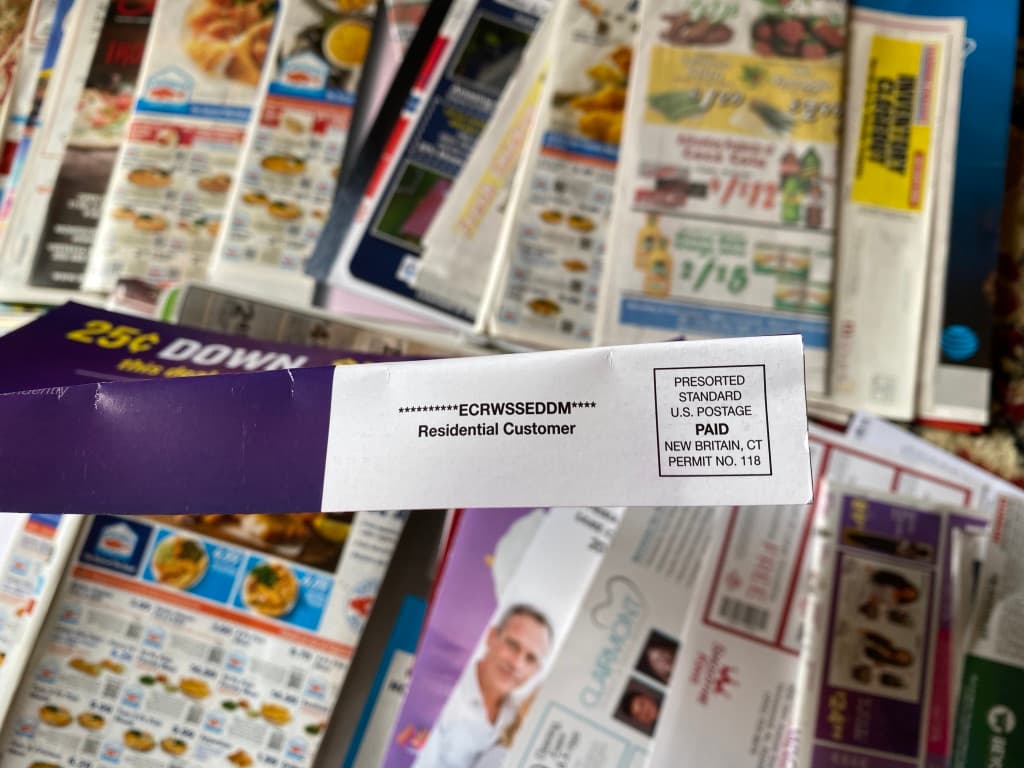
- “ECRWSSEDDM, Residential Customer” The saturation marking and a generic address. No name, no street: one copy goes to every mailbox on the carrier route.
- “Presorted Standard, U.S. Postage Paid” The advertiser paid USPS Marketing Mail rates through a permit. You paid nothing and were never asked.
The line of asterisks is an optional endorsement line. The asterisks are filler. What matters is the code at the right end: a price marking such as ECRWSS, often followed by the carrier route, written as a letter and three digits (C-001, for example). The letter tells you what kind of route it is:
- C: a city route
- R: a rural route
- H: a highway contract route
- B: a section of post office boxes
- G: general delivery
What do the other postal markings mean?
Here is every marking you are likely to find on advertising mail, what it says about how the piece reached you, and what you can do about it. The column that matters most is the street address: if yours is printed, the sender has a list, and you can ask to come off it.
| Marking | What it means | Your name on it? | Your street address on it? | Can you stop it? | How |
|---|---|---|---|---|---|
| PRSRT STDPRESORTED STANDARD, PRSRT MKTG | What it means: Bulk mail at USPS Marketing Mail prices, sorted by the sender before mailing. Most advertising travels this way. | Your name on it?Sometimes | Your street address on it?Usually; never on EDDM | Can you stop it?Depends on the address | HowCheck the address block, then use the row below that matches it. |
| ECRWSS | What it means: Enhanced Carrier Route, Walk-Sequence Saturation: the saturation price. Sorted in delivery order and sent to at least 90% of the homes or 75% of all addresses on a route. | Your name on it?Usually not | Your street address on it?Sometimes (“Resident” mail); never on EDDM | Can you stop it?Partly | HowIf your street address is printed, ask the sender to remove it. If not, see the EDDM row. |
| ECRWSSEDDMEDDM RETAIL in the postage box | What it means: Every Door Direct Mail: one piece for every address on the routes the sender picked, with no mailing list. | Your name on it?No | Your street address on it?No (“Postal Customer,” “Residential Customer”) | Can you stop it?One sender at a time | HowAsk each sender to list your address as Do Not Deliver on its USPS facing slip. How to ask |
| ECRWSH | What it means: Enhanced Carrier Route, Walk-Sequence High density: sorted in delivery order, at least 125 pieces on the route, short of saturation. | Your name on it?Sometimes | Your street address on it?Yes | Can you stop it?Yes | HowAsk the sender, or use DMAchoice, Catalog Choice or PaperKarma. |
| ECRLOT | What it means: Enhanced Carrier Route, Line-of-Travel: the basic carrier-route price, sorted in the order the carrier travels the route. | Your name on it?Usually | Your street address on it?Yes | Can you stop it?Yes | HowAsk the sender, or use DMAchoice, Catalog Choice or PaperKarma. |
| CAR-RT SORT | What it means: Carrier Route Presort: the carrier-route marking for Bound Printed Matter, such as bound catalogs and directories. | Your name on it?Usually | Your street address on it?Yes | Can you stop it?Yes | HowAsk the sender. Catalog Choice handles many catalogs. |
| NONPROFIT ORGNONPROFIT ORGANIZATION, NONPROFIT | What it means: Marketing Mail sent at nonprofit prices by an organization USPS has authorized. | Your name on it?Usually | Your street address on it?Usually; not on nonprofit EDDM | Can you stop it?Usually | HowAsk the organization. DMAchoice covers donation requests from participating groups you haven't given to in two years. |
| AUTO, 5-DIGITalso 3-DIGIT | What it means: Presort markings on addressed mail. AUTO means barcoded automation prices; 5-DIGIT or 3-DIGIT shows how the bundle was sorted by ZIP Code. | Your name on it?Usually | Your street address on it?Yes | Can you stop it?If it's an ad | HowPrescreened credit and insurance offers: OptOutPrescreen. Other ads: ask the sender or use DMAchoice. |
| PRSRT FIRST-CLASSPRESORTED FIRST-CLASS MAIL | What it means: First-Class Mail sent in bulk at presort prices: bills, statements and some advertising. | Your name on it?Yes | Your street address on it?Yes | Can you stop it?If it's an ad | HowAsk the sender. Refused unopened, First-Class Mail goes back to the sender at no charge. |
Sources: USPS Domestic Mail Manual 202.3, 203.7, 507 and 602.3; Quick Service Guide 240g; USPS Every Door Direct Mail Quick Reference.
Is all ECRWSS mail EDDM?
No. EDDM is one kind of ECRWSS mail. USPS delivered about 9.7 billion saturation pieces in fiscal 2025, and Every Door Direct Mail accounted for nearly 3 billion of them. More than 6 billion were something else, such as shared coupon envelopes that print “Resident” above a street address.
The address block tells you which kind you are holding:
Postage box: PRSRT STD, ECRWSS, U.S. Postage Paid, EDDM Retail. Address: Local Postal Customer.
EDDM Retail. The retail version, dropped off at the post office. No name and no street address: every mailbox on the route gets one.
Postage box: PRSRT STD, U.S. Postage Paid, Anytown, Permit No. 123. Address: ECRWSSEDDM, Residential Customer.
EDDM from a bulk mailer. “EDDM” is joined to “ECRWSS” and postage is paid by permit. Still no street address.
Postage box: PRSRT STD, U.S. Postage Paid, Mailer Name. Address: ECRWSS, carrier route C-001, Resident, 123 Main St, Anytown.
Saturation mail from a list. Same ECRWSS rate, but a street address is printed, so the sender can remove it.
“ECRWSSEDDM” simply joins the two. USPS's EDDM guidance shows it above the simplified address on EDDM mailings entered at a business mail entry unit, and requires “EDDM” after “ECRWSS” on pieces between 10.5 and 11.5 inches long.
What do PRSRT STD and “U.S. Postage Paid” mean?
PRSRT STD stands for Presorted Standard: bulk mail paid at USPS Marketing Mail prices, the class that carries most advertising. “Presorted” means the sender sorted the mail by ZIP Code or carrier route before handing it over, in exchange for lower postage. Standard Mail is the class's former name, and USPS still accepts the marking alongside “PRSRT MKTG.”
“U.S. Postage Paid” means the sender paid for the whole mailing at once instead of stamping each piece. The rest of the box says how:
- A city, state and permit number. The permit is held at that post office, and USPS lets a permit pay for mailings entered elsewhere. The flyer in our photo carries a permit from New Britain, Connecticut.
- A company name instead of a city. This is a company permit imprint, which names the permit holder. That can be a mailing company working for the advertiser on the front.
- EDDM RETAIL. The retail version of Every Door Direct Mail, which needs no permit and is dropped off at the post office. USPS prescribes the whole box: PRSRT STD, ECRWSS, U.S. POSTAGE, PAID, EDDM RETAIL.
- NONPROFIT ORG. Appears in place of PRSRT STD when an organization USPS has authorized mails at nonprofit prices.
What does “ECRWSS Postal Customer” mean?
It means you are holding saturation mail with a simplified address: the sender paid the ECRWSS rate and printed “Postal Customer” instead of a name and street. USPS requires that wording when a piece goes to every home and business on a city route, and allows “Residential Customer” when it goes to every home. Most of it is EDDM.
How Postal Customer, Residential Customer and Current Resident mail differ.
Why is saturation mail the cheapest USPS rate?
Because the sender does the sorting and USPS does little more than carry it. Saturation pieces arrive already in the carrier's delivery order, and EDDM Retail must be dropped at the post office that delivers it. The Postal Regulatory Commission found that an EDDM Retail piece cost USPS 6.5 cents to handle in fiscal 2025 and brought in 22.8 cents.
| Price category | Postage per piece |
|---|---|
| Saturation (ECRWSS) | 25.8¢ |
| Commercial EDDM, sent by bulk mailers with a permit | 25.9¢ |
| EDDM Retail, no permit needed | 26.0¢ |
| High density (ECRWSH) | 32.3¢ to 35.4¢ |
| Basic carrier route (ECRLOT) | 45.4¢ |
| Forever stamp on a one-ounce letter, for comparison | 82¢ |
Flats up to 4 ounces entered at the delivery post office (EDDM Retail: up to 3.3 ounces). Source: USPS Notice 123, effective October 4, 2026; Marketing Mail prices have not changed since July 12, 2026.
Bulk saturation flats also got the smallest increase in the July 2026 price change: high-density and saturation flats went up 1.4% on average, the least of any Marketing Mail product, against 4.8% for First-Class Mail. EDDM Retail rose 5.3%.
Can I stop ECRWSS mail?
It depends on one line: whether your street address is printed on the piece.
- Your street address is printed, under “Resident,” “Current Resident” or your name. The sender mailed from an address list and can take you off it. Coupon mailers such as Valpak have online removal forms, and our guide to stopping addressed junk mail covers the rest.
- No street address: “Postal Customer,” “Local Postal Customer” or “Residential Customer.” This is EDDM or other simplified-address mail, and no household opt-out exists. The one lever is asking each sender to list your address as Do Not Deliver on the paperwork it files with USPS.
ECRWSS questions, answered
What is a carrier route?
The set of addresses one carrier delivers to. USPS identifies each route by ZIP Code plus a route code such as C012 (a city route) or R004 (a rural route). EDDM advertisers choose routes, not people.
Can an advertiser see who lives on my route?
Not through EDDM. The USPS EDDM tool shows how many homes and businesses each route has and lets advertisers filter routes by Census-based age, household size and income. It works route by route and needs no names.
Do nonprofits and political campaigns use ECRWSS?
Yes. Authorized nonprofits can send saturation mail, EDDM included, at nonprofit prices, and USPS markets EDDM to local political campaigns. The marking describes the postage rate, not the sender.
Can a business skip the Post Office and put flyers in my mailbox?
No. Federal law (18 U.S.C. 1725) makes it an offense, punishable by a fine, to put circulars or other mailable matter in a mailbox without paying postage on it.
Will DMAchoice or PaperKarma stop ECRWSS mail?
Only when your name or street address is printed on it. DMAchoice says its opt-out “will not work to stop EDDM mailings,” and PaperKarma says mail “carpet-bombed to every address in a ZIP code” has no list to take you off of.
Is Presorted Standard mail forwarded when I move?
Usually not. USPS disposes of undeliverable Marketing Mail unless the sender printed an endorsement such as “Address Service Requested,” and mail addressed to “Resident” or “Postal Customer” is never forwarded.
Is ECRWSS mail junk mail?
By the everyday definition, advertising nobody asked for, usually yes. The marking itself only says the sender paid the saturation rate, the lowest price USPS offers for reaching every mailbox on a route.
Sources
- USPS Quick Service Guide 240g, Marketing Mail carrier route flats (ECRLOT, ECRWSH, ECRWSS, density rules), accessed October 2026
- USPS Domestic Mail Manual 202.3, price markings
- USPS Domestic Mail Manual 203.7 and 203.8, endorsement lines and carrier route codes
- USPS Domestic Mail Manual 602.3, simplified, occupant and exceptional addresses
- USPS Domestic Mail Manual 144, EDDM Retail indicia and “do not deliver” list
- USPS Domestic Mail Manual 604.5, permit imprints
- USPS Domestic Mail Manual 507, treatment of undeliverable mail
- USPS Every Door Direct Mail Quick Reference (PDF), 2012
- USPS: Every Door Direct Mail, accessed October 2026
- USPS Notice 123, price list, effective October 4, 2026
- USPS Postal Facts: Every Door Direct Mail, updated May 15, 2026
- USPS Revenue, Pieces and Weight report, FY2025
- USPS Form 10-K, FY2008 (glossary: Enhanced Carrier Route)
- Postal Regulatory Commission, Financial Analysis of USPS FY2025, May 21, 2026
- Postal Regulatory Commission, Order No. 9584 (July 2026 prices), May 27, 2026
- 18 U.S.C. 1725, postage unpaid on deposited mail matter
- DMAchoice: Consumer Choices FAQs, accessed October 2026
- PaperKarma: How it works, accessed October 2026
- Valpak: unsubscribe request