What Is EDDM (Every Door Direct Mail)?
The Postal Service program behind the flyers addressed to “Postal Customer”: how it works, what ECRWSS means, what it costs advertisers, and why you can't opt out.
By Jake WaitzmanUpdated Sources linked throughout
Short answer: EDDM (Every Door Direct Mail) is a U.S. Postal Service program that lets a business mail one advertisement to every address on a postal carrier route, with no names and no mailing list. The flyers arrive addressed to “Postal Customer” or “Residential Customer” and carry the ECRWSS marking. Households cannot opt out. The only exception is asking each advertiser to list your address as Do Not Deliver.
| Run by | U.S. Postal Service |
|---|---|
| Started | Market test in 2011; a permanent product since January 2013 |
| Addressed to | “Postal Customer,” “Local Postal Customer” or “Residential Customer” |
| Postal markings | PRSRT STD, ECRWSS, U.S. POSTAGE PAID, EDDM RETAIL |
| Price | 26 cents per piece (EDDM Retail, since July 12, 2026) |
| Volume | Nearly 3 billion pieces in fiscal 2025 |
| USPS revenue | About $617 million in fiscal 2025 |
| Household opt-out | None. An advertiser can exclude an address if asked. |
How does EDDM work?
A business picks neighborhoods, prints flyers and hands them to the Postal Service, which puts one in every mailbox on each chosen carrier route. No names or addresses are involved: the sender only needs the route, which is why it is cheaper and simpler than buying a mailing list.
- Choose the routes. USPS's EDDM online tool shows every carrier route on a map with its household count. USPS tells businesses they can use it to “target customers by specific demographics such as age, household size, and income” using Census data. Your street is chosen because of who lives on it, not at random.
- Print the flyers. EDDM Retail pieces must be flats, larger than a letter, printed with a simplified address and the EDDM postage marking.
- Drop them off. EDDM Retail mailers bring bundles to the local post office (up to 5,000 pieces a day per ZIP Code, no permit needed). Larger commercial mailers enter them through a business mail entry unit (BMEU) under a permit.
- Delivery to every address. Carriers deliver one piece to every address on the route. USPS rules require complete distribution of simplified-address mail, and a household cannot ask its carrier to skip it.
What does ECRWSS mean?
ECRWSS stands for Enhanced Carrier Route, Walk-Sequence Saturation. It means the mailer paid the saturation rate: pieces sorted in the order the carrier walks the route, going to nearly every address on it (at least 90% of residences or 75% of all deliveries, and 100% when the piece uses a simplified address like “Postal Customer”). EDDM uses this marking, often printed as “ECRWSSEDDM” or alongside “EDDM RETAIL.” Other saturation mailers use it too, including coupon packs that print “Resident” above your street address.
Decode every marking on your mail: ECRWSS, PRSRT STD, ECRLOT and more.
Why is it addressed to “Postal Customer”?
USPS allows a simplified address on saturation mail: a generic line instead of a name and street. “Postal Customer” is required when a piece goes to every delivery on a city route; “Residential Customer” covers homes only; “Local” can stand in for the city and state. Mail addressed to “Current Resident” or “Occupant” is different: it carries your street address and comes from a list, which means it can usually be stopped.
Postal Customer, Current Resident and Occupant mail, explained.
How do I recognize EDDM mail?
Look for three things on the address side:
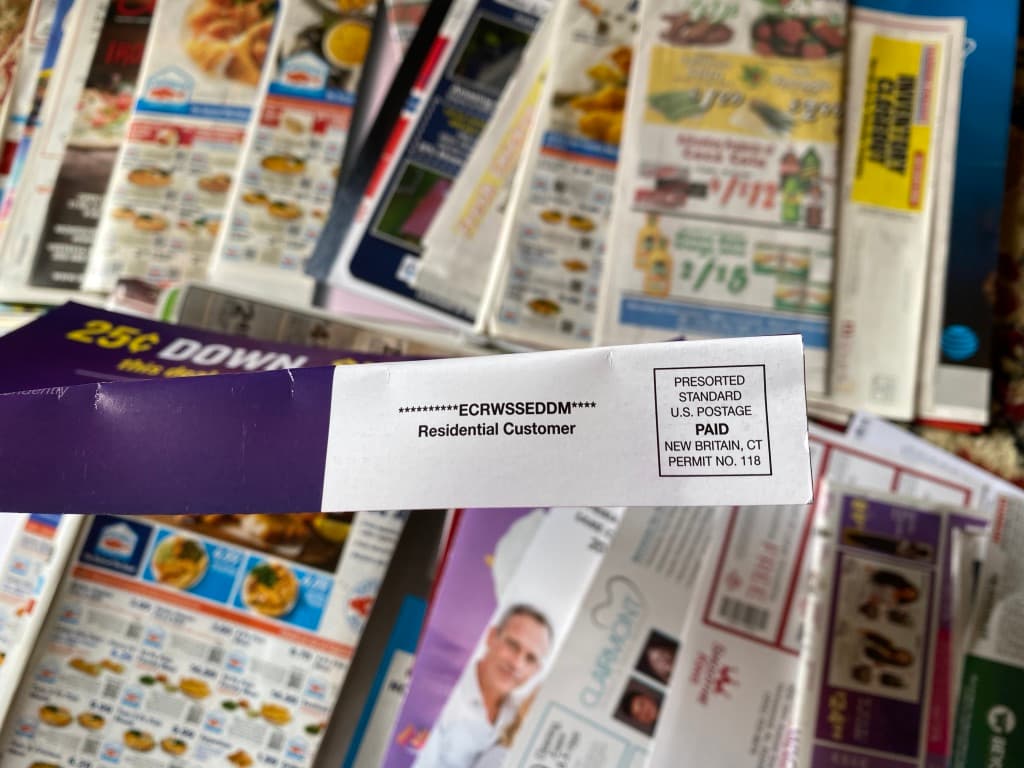
- “ECRWSSEDDM, Residential Customer” The saturation marking and a generic address. No name, no street: one copy goes to every mailbox on the carrier route.
- “Presorted Standard, U.S. Postage Paid” The advertiser paid USPS Marketing Mail rates through a permit. You paid nothing and were never asked.
- A generic recipient line: “Postal Customer,” “Local Postal Customer” or “Residential Customer”
- No name and no street address
- A postage box reading PRSRT STD (Presorted Standard) with ECRWSS, EDDM RETAIL or a permit number
What does EDDM cost advertisers?
Since July 12, 2026, an EDDM Retail flyer costs 26 cents to mail, about a third of the 82-cent Forever stamp. Commercial mailers entering EDDM at the destination post office pay as little as 25.9 cents. In the July 2026 price change, EDDM Retail rose 5.3%, while commercial saturation and high-density flats rose only about 1.4% on average, against 4.8% for First-Class Mail.
| Price change | EDDM Retail, per piece |
|---|---|
| January 2020 | 19.1¢ |
| August 2021 | 20.0¢ |
| July 2023 | 19.8¢ |
| July 2024 | 22.3¢ |
| July 2025 | 24.7¢ |
| July 2026 | 26.0¢ |
Source: USPS Notice 123 price lists in effect on each date. EDDM Retail rose 36% from January 2020 to July 2026.
How much EDDM does the Postal Service deliver?
USPS sent nearly 3 billion EDDM pieces in fiscal 2025 and earned about $617 million from them. Counting all saturation advertising, mail sent to nearly every address on a route, the total was about 9.7 billion pieces. Advertising overall (Marketing Mail) was 56.8 billion pieces, 52% of everything USPS delivered that year, down 45% from its 2007 peak.
In 2026 the Postal Service is pushing for more. Marketing Mail revenue rose 12.3% from April to June 2026, and USPS is paying a 30% postage credit to mailers who grow their 2026 Marketing Mail volume, saturation mail included.
Can you opt out of EDDM?
No household opt-out exists. There is no registry, no USPS form, and refusing a piece does nothing: USPS throws refused “Postal Customer” mail away instead of returning it, so the sender never finds out.
Is EDDM junk mail?
By the usual definition, unrequested advertising, yes. It is legal, and it is an official USPS product, but no one on the route asked for it. The Postal Service's own household survey found that ads from businesses a household has no relationship with were read only 36% of the time, and that households threw away 39% of all advertising mail without reading it.
What arrives through EDDM?
Anything an advertiser can fit on a flat: grocery circulars, pizza menus, dental offers, roofing and lawn ads, real estate postcards. Because no one is screened out, that includes material some households would never choose to receive.

A short history of EDDM
- 2008. USPS creates a procedure for rural customers who ask a specific mailer to stop delivering simplified-address mail to them (the Rural Boxholder Non-delivery Request).
- January 2, 2011. USPS extends the “Postal Customer” simplified address to every city route and extends the same per-mailer “do not deliver” procedure.
- March 31, 2011. EDDM Retail begins as a market test. By that November the Postal Regulatory Commission reported that 87% of its revenue came from new customers.
- August 2012. The Direct Marketing Association launches a voluntary EDDM suppression form. By 2022 the form was gone.
- October 15, 2012. USPS publishes the final rule making EDDM Retail a permanent product, effective January 27, 2013. The rule says nothing about opting out.
- 2026. USPS offers mailers a 30% postage credit for growth in Marketing Mail, saturation mail included, while the agency looks for revenue to cover continuing losses.
Does EDDM keep the Postal Service afloat?
The usual defense of EDDM is that the Postal Service loses billions and cannot afford to let households opt out. The numbers don't support it.
| EDDM revenue, FY2025 | About $617 million |
|---|---|
| USPS operating revenue, FY2025 | $80.5 billion (EDDM is 0.8%) |
| USPS net loss, FY2025 | $9.0 billion (EDDM revenue equals about 7% of it) |
| USPS net losses since 2007 | $118 billion (GAO) |
| Pension contributions paused, through September 2026 | About $2.5 billion (USPS estimate) |
EDDM is profitable per piece: the Postal Regulatory Commission found EDDM Retail brought in 22.8 cents a piece against 6.5 cents of cost in fiscal 2025. But the whole program is less than 1% of USPS revenue, and an opt-out would apply only to the households that chose it. When the Postmaster General laid out options for Congress in 2026, they were delivery cuts, higher postage, appropriations and more borrowing. EDDM was not on the list.
An opt-out would not decide the Postal Service's future. It would decide whether the people who pay for the Postal Service get a say in what it delivers to them.
How do other countries handle unaddressed advertising?
Several countries let households say no, including Canada, where the national postal operator itself honors the request.
| Country | What households can do |
|---|---|
| Canada | Canada Post honors a household's request to stop unaddressed advertising (its Consumers' Choice policy). Montreal went further in 2023 with an opt-in bylaw; flyer tonnage on the island fell 84% by 2024. |
| United Kingdom | Royal Mail runs a free Door to Door opt-out for unaddressed mail. It takes effect in about six weeks and is renewed every two years. |
| Netherlands | Opt-out stickers nationwide. Amsterdam switched to opt-in in 2018: ads arrive only where a “ja/ja” sticker invites them. By April 2024, 70 of the country's 342 municipalities had followed. |
| Germany | A “no advertising” sticker on the mailbox is legally binding on distributors, a rule the Federal Court of Justice set in 1988. |
| France | A “Stop Pub” sticker, with fines of up to 1,500 euros for ignoring it. An opt-in trial ran in 14 areas from 2022 to 2025 but was not extended nationwide. |
| United States | No household opt-out. Each advertiser can choose to exclude an address on its USPS paperwork if asked. |
Why the U.S. has no Do Not Mail registry, and who has tried to create one.
EDDM questions, answered
What does EDDM stand for?
EDDM stands for Every Door Direct Mail, a U.S. Postal Service product that delivers one advertising piece to every address on the carrier routes a sender picks, without names or a mailing list.
Is EDDM legal?
Yes. EDDM is an official USPS product, made permanent by a 2012 rule (Federal Register 2012-25059). Federal law (18 U.S.C. 1725) reserves your mailbox for postage-paid mail, and the Supreme Court upheld that restriction in 1981.
Can I refuse EDDM mail or return it to sender?
You can refuse it, but it accomplishes nothing. USPS rules say refused mail with a simplified address like “Postal Customer” is disposed of as waste rather than returned, so the advertiser never learns you refused it.
Does a “No Junk Mail” sign stop EDDM?
No. USPS rules require carriers to deliver simplified-address mail to every delivery on the route, and no rule lets a household opt out by posting a sign.
Do DMAchoice, Catalog Choice or PaperKarma stop EDDM?
No. They work by removing your name from mailing lists, and EDDM uses no list. PaperKarma says so itself: mail sent to every address in a ZIP Code has no list to take you off of.
Who sends EDDM mail?
Mostly local businesses such as restaurants, grocery stores, dentists, real estate agents and home-service companies, plus national chains. USPS markets EDDM to small businesses as a way to reach a neighborhood without buying a list.
How many EDDM pieces are sent each year?
Nearly 3 billion pieces in fiscal 2025, according to USPS Postal Facts. Counting other saturation mail sent to nearly every address on a route, the total was about 9.7 billion pieces.
Does EDDM keep the Postal Service afloat?
No. EDDM brought in about $617 million in fiscal 2025, roughly 0.8% of USPS's $80.5 billion in operating revenue and about 7% of that year's $9 billion loss. An opt-out for the households that want one would not decide the agency's finances.
Sources
- USPS Postal Facts: Every Door Direct Mail (EDDM), Fact #291, updated May 15, 2026
- USPS: Every Door Direct Mail (prices, Do Not Deliver Address instructions), accessed October 2026
- USPS Notice 123, price list, effective July 12, 2026
- USPS Domestic Mail Manual 602.3, simplified address formats
- USPS Domestic Mail Manual 143 to 145, EDDM Retail rules
- Federal Register 2012-25059, Every Door Direct Mail-Retail final rule, October 15, 2012
- Postal Bulletin 22300, Extension of the Simplified Address Format, December 16, 2010
- USPS reports fiscal year 2025 results, November 14, 2025
- USPS Revenue, Pieces and Weight report, FY2025
- Postal Regulatory Commission, Financial Analysis of USPS FY2025, May 21, 2026
- U.S. GAO, GAO-26-109008, U.S. Postal Service financial condition, March 17, 2026
- USPS PostalPro, Mail Growth Incentives, 2026
- VNG (Association of Netherlands Municipalities): ja/ja sticker FAQ, updated September 2024
- Canada Post: Consumers' Choice
- French Ministry of Ecological Transition: Stop Pub (fines under Environmental Code art. L541-15-15)